
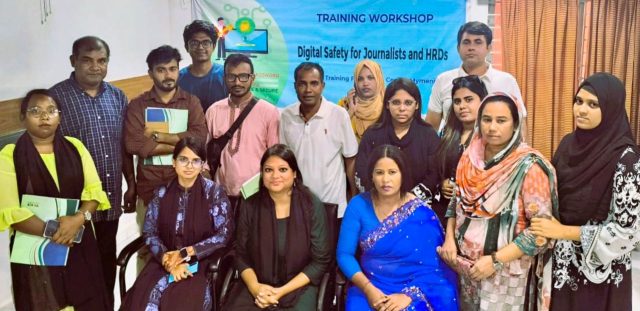
Digital safety is no longer a concern exclusive to tech experts. It is now deeply intertwined with journalism and the defense of human rights. With this message in focus, a day-long training workshop titled “Digital Safety for Journalists and Human Rights Defenders” was held on 9 August 2025 at Spandan Training Facilitation Centre in Mymensingh.
The workshop was organized by the rights-based research organization VOICE (Voices for Interactive Choice and Empowerment). Participants included young journalists working in local newspapers, television, and online media platforms, as well as representatives from various human rights organizations.
Through practical, hands-on sessions, participants received training on multiple aspects of digital safety and online protection, including threat modeling, safe browsing and communication, encryption, two-factor authentication, digital hygiene, and privacy awareness.
Ahmed Swapan Mahmud, Executive Director of VOICE, said, “With increasing incidents of surveillance, harassment, and repression by the state, corporations, and individuals in the digital space, it is imperative that we rethink our approach to digital safety.” He added that strengthening digital literacy is equally essential to empower individuals to navigate and protect themselves in an increasingly complex online environment.
The digital protection strategies were presented by VOICE Project Manager Promiti Prova Chowdhury. She remarked, “Using secure communication channels can significantly reduce digital threats and harassment, which is especially vital for women journalists and rights defenders.”
The workshop covered key topics through hands-on activities, including threat modeling for self-risk analysis, the use of artificial intelligence, strong passwords, two-factor authentication for critical social media accounts, VPNs, safe browsing with Tor Browser, encrypted communication, and data backup.
Participants also practiced identifying malicious links, safeguarding mobile devices and social media privacy, and protecting their digital security while reporting in the field; such as by avoiding public Wi-Fi and disabling geo-location tracking.
The workshop was facilitated by digital safety expert Ashraful Haque.