
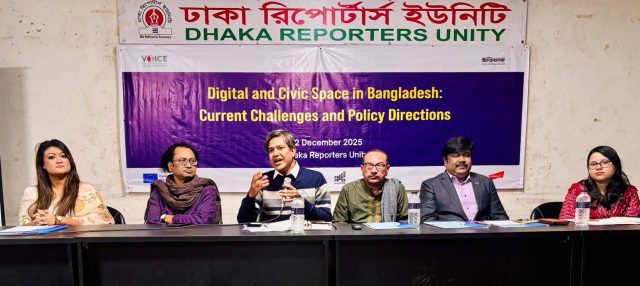
Dhaka, 22 December 2025
A multi-stakeholder consultation titled “Digital and Civic Space in Bangladesh: Current Challenges and Policy Directions” was convened today at Dhaka Reporters Unity in the capital. The consultation brought together a wide cross-section of participants, including civil society organisations, activists, media professionals, women and youth representatives, lawyers, academicians, marking a significant step toward strengthening collective action on digital and civic space in Bangladesh.
The event condemned the assassination of Sharif Osman Hadi, highlighting the violent suppression of alternative voices. Speakers also raised concerns about subsequent mob attacks, fueled by online disinformation, which targeted two major newspapers, Prothom Alo and the Daily Star, physically harassed women journalists and public intellectuals like Nurul Kabir. Cultural institutions were vandalized as well, reflecting retaliatory efforts to silence independent and progressive spaces.
The event provided an essential platform for participants to share experiences and reflect on the shrinking digital and civic space in the country. Discussions centred on key concerns such as online gender disinformation and civic suppression, mob terrorism, fundamentalist uprisings, repressed press freedom, violence against journalists and practical recommendations.
Delivering the keynote presentation, Musharrat Mahera, Deputy Director, Programmes at VOICE, highlighted about understanding the digital and civic rights. “Digital and civic space is shaped by laws, policies, institutions and social practices. There is a notable rise in targeted propaganda campaigns against women on social media, termed as gender disinformation, that brings division, chaos, and spreads hatred, disturbing societal peace and harmony” she said. She urged to promote inclusive, peaceful political engagement as a recommendation.
The panel discussion featured distinguished speakers who brought sociocultural, political, policy, and development perspectives to the consultation. Dr. Zahed Ur Rahman, columnist and activist said, “In the face of widespread human rights challenges, nationally and globally, online and offline, responsible citizens must stand firm against all violations. We must not step back, but continue to raise our voices from where we stand.”
Abul Hasan Rubel, Executive Coordinator, Ganosanhati Andolon said, “In the aftermath of the mass uprising, a troubling reality has emerged. Acts of violence against women are being openly celebrated. Meanwhile, the language of inclusion is being misused to justify discriminatory practices.”
Media personality Dipty Chowdhury stated, “Freedom of speech allows individuals to express their ideas and beliefs, provided the rights of others are protected. When a violation does occur, it is the responsibility of the state to intervene and ensure justice.”
Human rights activist and policy analyst Monjur Rashid focused on civil rights. He said, “Every citizen possesses fundamental rights. When individuals raise strong voices from their respective positions, meaningful change becomes inevitable. A strong democracy is built when people unite and move forward together.”
Online disinformation specialist Tamara Yesmin Toma said, “At present, false information circulates rapidly concerning both men and women; however, it propagates more swiftly when women are specifically targeted. Law enforcement agencies must adopt a firm and proactive approach. Through careful investigation, offenders must be held accountable, thereby reinforcing the rule of law.”
Ahmed Swapan Mahmud, Executive Director of VOICE, reiterated the organisation’s long-standing commitment to defending digital freedom, media rights, and the safety of frontline defenders. “At a time when digital repression and disinformation are intensifying, it is vital that we stand together to protect the rights of those most at risk. Today’s consultation reflects our collective resolve to push for transparency, accountability, and rights-based governance in the digital realm,” he said.
Speakers stressed the importance of inclusive digital policies, transparency in governance, robust media and information literacy, and targeted protection mechanisms for women, journalists, indigenous activists, and other disadvantaged communities who disproportionately face discrimination, online and offline harassment and threats.