
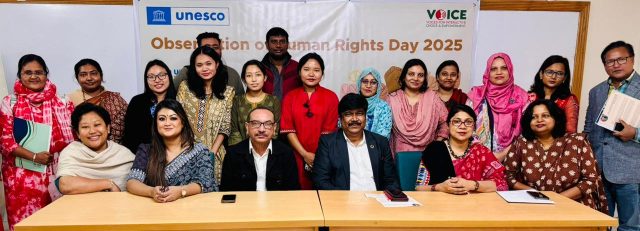
VOICE, a rights-based organisation working to advance freedom of expression, digital rights, and inclusive civic space, today marked Human Rights Day 2025 through a public event in Lalmatia, Dhaka, supported by UNESCO, following the conclusion of the 16 Days of Activism Against Gender-Based Violence campaign. The programme brought together journalists, civil society representatives, human rights activists, women leaders, youth representatives, and indigenous community leaders to collectively reflect on pressing human rights challenges in Bangladesh, with a particular focus on digital violence against women and girls and journalists’ safety following the July Uprising.
Observed globally on 10 December, Human Rights Day commemorates the adoption of the Universal Declaration of Human Rights (UDHR) and serves as a reminder that human rights are not abstract principles, but lived guarantees essential to dignity, equality, and justice. Speaking at the event, participants emphasized that periods of political transformation demand heightened protection of human rights, as civic engagement, dissent, journalism, and activism increasingly unfold within digital spaces where new forms of violence and repression have emerged.
The discussion was framed within the theme of 16 Days of Activism 2025: “End Digital Violence Against All Women and Girls First.” Panelists noted that technology-facilitated violence has become a major gateway to wider human rights violations. For women journalists, activists, and public figures, online harassment, sexualized threats, disinformation, and doxing often escalate into offline intimidation, surveillance, and physical attacks, undermining both personal safety and democratic discourse.
The keynote presentation, titled “Human Rights Situation Analysis: Ending Digital Violence and Defending Journalists,” was delivered by Musharrat Mahera, Deputy Director, Programmes, VOICE. She emphasized that digital violence directly violates freedom of expression, privacy, dignity, and participation in public life, and stressed that ending such violence is essential not only for gender justice but also for protecting press freedom and the public’s right to information. Reflecting on the post-July Uprising context, she noted that unchecked online threats normalize fear, shrink civic space, and undermine accountability, despite journalists’ critical role in documenting protests, state actions, and citizen voices.
Drawing on her long experience advocating for marginalized communities, Nadira Pervin, Programme Manager at Nagorik Uddyog, noted that rethinking activism to ensure more inclusive, co-created spaces is essential for achieving meaningful impact. She emphasized that the media also has a critical role to play by amplifying success stories through positive, responsible storytelling that resonates with the broader public and builds collective support.
Highlighting institutional responsibility, human rights analyst and activist Monjur Rashid said, “Protecting journalists and addressing digital violence must be treated as a human rights obligation. This requires legal reform, accountable institutions, and cross-sector collaboration so that technology strengthens democracy rather than undermines it. As the national election approaches, political parties must clearly commit to human rights and be accountable for delivering on those commitments.”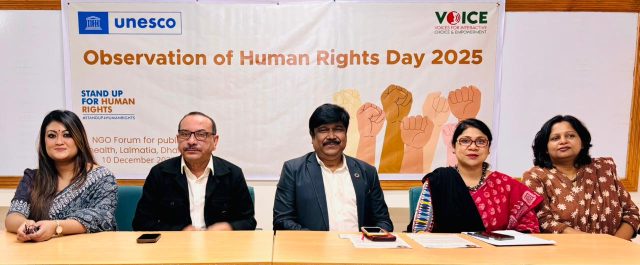
Ahmed Swapan Mahmud, Executive Director of VOICE, emphasized the urgency of action, noting, “Human rights cannot wait, especially during times of political transition. When journalists are attacked and women are silenced, society as a whole loses. Ending digital violence and ensuring journalist safety is central to rebuilding trust, justice, and democratic resilience.”
Reflecting on newsroom realities, the journalist community stated, “Journalists have faced unprecedented risks since July, from physical assaults on the streets to coordinated online smear campaigns. For women reporters, these threats are compounded by gendered abuse designed to destroy credibility and push them out of public life.”
Throughout the discussion, speakers highlighted that since the July Uprising, journalists in Bangladesh have reported physical assaults and mob violence while covering protests and political demonstrations, confiscation of equipment, obstruction of reporting, arbitrary detention, judicial harassment under cyber and criminal laws, and sustained online intimidation. Women journalists, in particular, have faced sexualized threats, attacks against family members, and disinformation campaigns aimed at character assassination, forcing many to self-censor or withdraw from assignments.
The event concluded with a shared call for coordinated, rights-based action, urging recognition of digital violence as a human rights violation, reform of laws in line with international standards, establishment of gender-sensitive protection mechanisms for journalists, strengthened digital safety and psychosocial support, and accountability for attacks on media workers.
Through this Human Rights Day observance, VOICE reaffirmed that ending digital violence against women and girls must be prioritized as a foundation for protecting freedom of expression and democratic participation. As Bangladesh navigates the post-July landscape, participants stressed that defending journalists and centring women’s rights are essential steps toward honouring the promise of the UDHR, not only in principle, but in practice.